
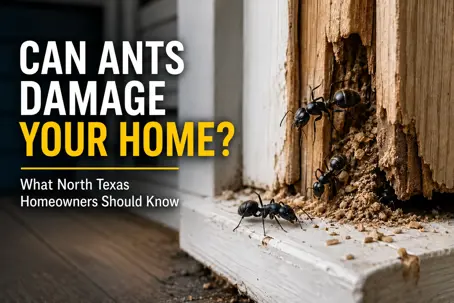
Can Ants Damage Your Home?
What North Texas homeowners should know about carpenter ants.
Most ants around your home are a nuisance, but carpenter ants can damage wood over time.
Unlike termites, carpenter ants don't eat wood. They excavate it to create tunnels and nesting areas.
We've seen an unusual amount of carpenter ant activity and flying ants around North Texas this August, making it especially important for homeowners to know what they're looking at.
If you're repeatedly seeing large ants or flying ants around your home, it's worth finding out where they're coming from.
Need Help Now?
Seeing unusually large ants or flying insects and aren't sure what they are?
Myles Pest Services can help identify what's happening and determine whether there's a colony that needs attention.
And if those flying insects turn out to be termite swarmers instead of ants, we can help with that too.
That's part of providing A Higher Standard of Pest Protection.
Related Services
Can Carpenter Ants Damage Your Home?
Yes.
Carpenter ants can damage wood when they excavate it to create nesting galleries.
However, there's an important distinction:
Carpenter ants don't eat wood like termites do.
Instead, they remove small amounts of wood as they expand their nesting areas. Over time, a large or established colony can damage the wood where it's nesting.
That doesn't mean finding one large ant automatically means your home has structural damage.
The bigger question is where the ants are coming from and whether a colony is established in or around the home.
Why Are We Seeing Carpenter Ants Right Now?
Carpenter ants aren't unusual in North Texas, but our technicians have noticed more carpenter ant problems and flying ant activity than we would normally expect this August.
Pest activity doesn't always follow a perfect calendar.
Heat, moisture, rainfall, irrigation, food availability, and nesting conditions around a property can all affect when ants become noticeable.
That's why we pay attention to what's actually happening in neighborhoods across North Texas—not simply what a pest is "supposed" to be doing during a particular month.
What Does It Mean If You're Seeing Flying Ants?
Flying ants are reproductive members of an established ant colony. Pest professionals often refer to these winged ants as swarmers or alates.
Their job is to leave an established colony, mate, and potentially begin new colonies.
Seeing a few flying ants outdoors doesn't necessarily mean you have a problem inside your home.
Seeing numerous flying ants inside the house is different.
Pay particular attention if they're appearing around or emerging from:
- Walls
- Window or door frames
- Baseboards
- Ceilings
- Attic areas
- Other cracks or openings in the structure
That type of activity may indicate a mature colony is located somewhere in or near the home.
There's another important reason flying ants deserve a closer look:
Flying ants are often mistaken for termite swarmers.
Is It a Flying Ant or a Termite?
It's easy to confuse the two, especially when winged insects suddenly appear around windows, doors, or inside the house.
Here are a few differences homeowners can look for.
Flying Ants
Flying ants typically have:
- A narrow or pinched waist
- Bent or elbowed antennae
- Front wings that are longer than their back wings
Termite Swarmers
Termites typically have:
- A broader, more uniform body
- Straight antennae
- Two pairs of wings that are approximately the same length
If you're unsure, don't feel like you have to identify them yourself.
Take a clear photo or, if possible, save one of the insects for identification.
Because carpenter ants and termites require very different approaches, correct identification should come before treatment.
Do Carpenter Ants Eat Wood Like Termites?
No.
This is one of the most common misconceptions about carpenter ants.
Termites eat wood. Carpenter ants excavate wood.
Carpenter ants create smooth galleries inside wood where the colony can nest. As they excavate, they may push debris out of the nesting area.
Both pests can be associated with wood damage, but they cause that damage in very different ways.
That's why simply seeing a large ant—or even finding damaged wood—isn't enough to determine exactly what's happening.
Does Seeing Carpenter Ants Mean You Have a Moisture Problem?
Not necessarily, but it's something worth checking.
Carpenter ants are often associated with wood that has been softened or affected by moisture.
Potential problem areas can include:
- Roof leaks
- Plumbing leaks
- Window and door frames
- Bathrooms
- Kitchens
- Attics
- Areas around exterior water damage
- Wood exposed to persistent moisture
Outdoor colonies may also be associated with trees, stumps, landscape timbers, firewood, or other wood around the property.
Seeing carpenter ants doesn't automatically mean your home has water damage.
But if ants repeatedly appear around the same area, looking for an underlying moisture issue can be an important part of determining why they're there.
What Are Myles Technicians Seeing?
This August, our technicians have encountered more carpenter ant activity and flying ants than we would normally expect this time of year.
That's important because large ants and flying insects can create a lot of uncertainty for homeowners.
Is it just an ant?
Is there a nest somewhere in the house?
Is it a carpenter ant?
Could those flying insects actually be termites?
Those questions can't always be answered by spraying the insects you can see.
Our approach starts with identifying the pest and understanding where the activity is coming from before recommending what should happen next.
Sometimes the ants are simply foraging into the home from an outdoor colony. Other times, repeated activity may point to a nesting site that needs to be addressed.
At Myles Pest Services, we believe homeowners deserve an honest answer before they receive a treatment recommendation.
That's part of A Higher Standard of Pest Protection.
Experience a Higher Standard of Pest Protection
Not every ant sighting means your home is being damaged.
But repeated carpenter ant activity or flying ants appearing inside shouldn't be ignored.
The goal isn't to make the problem sound worse than it is. It's to identify what's happening, determine where the activity is coming from, and recommend the appropriate next step.
That's the difference between simply treating what you can see and understanding the problem behind it.
Why Do Carpenter Ants Keep Coming Back?
The ants you see walking across a wall, countertop, or windowsill may represent only a small part of a much larger colony.
Spraying those individual ants can kill the ones you see without necessarily reaching the source of the activity.
Carpenter ants may be:
- Foraging indoors from an outdoor colony
- Traveling between nesting areas
- Following moisture or food sources
- Nesting somewhere within the structure
If large ants continue appearing in the same area, finding the source becomes more important than repeatedly treating individual ants.
When Should You Have Carpenter Ant Activity Checked?
Consider having the activity evaluated if:
- You're repeatedly seeing large ants indoors.
- You're finding numerous flying ants inside.
- Ants appear to be emerging from a wall, ceiling, window, or another part of the home.
- Activity continues after DIY treatments.
- You suspect moisture-damaged wood.
- You find debris near a suspected nesting area.
- You can't tell whether the flying insects you're seeing are ants or termites.
One carpenter ant isn't necessarily an emergency.
A pattern of activity is what deserves attention.
Continue Learning
- Why Are Ants Suddenly Everywhere in North Texas?
- How to Tell the Difference Between Carpenter Ants and Termites
- Termite Control and Prevention in North Texas
- How to Protect Your Home Inside and Out with Comprehensive Pest Management
Related Services
Frequently Asked Questions
Can carpenter ants damage a house?
Yes. Carpenter ants excavate wood to create nesting galleries. They don't consume wood like termites, but a colony that remains active in a structure over time can cause damage.
Does seeing one carpenter ant mean I have an infestation?
No. A single carpenter ant may simply be foraging. Repeated sightings, numerous large ants, or flying ants appearing indoors are stronger reasons to investigate where the activity is coming from.
Why am I seeing flying ants in my house?
Flying ants are reproductive members of an established colony. A few outdoors may be normal, but numerous flying ants appearing indoors or emerging from part of the structure may indicate a colony nearby.
Are flying ants the same as termites?
No. Flying ants and termite swarmers are different insects, although homeowners often confuse them. Ants typically have pinched waists and elbowed antennae, while termites have broader bodies and straight antennae.
Do carpenter ants eat wood?
No. Carpenter ants excavate wood to create nesting galleries. Termites actually consume wood.
Do carpenter ants mean I have a water leak?
Not necessarily. Carpenter ants are often associated with moisture-affected wood, so repeated activity can be a reason to look for moisture problems. Their presence alone doesn't prove that your home has a leak.
Should I spray carpenter ants when I see them?
Spraying individual ants may kill the ants you can see without addressing the colony producing them. When carpenter ants repeatedly appear, identifying the species and locating the source of the activity is more important than simply treating individual ants.
Experience a Higher Standard of Pest Protection
When an unusual pest suddenly appears around your home, knowing what you're looking at is often the most important first step.
That's especially true with carpenter ants and flying ants. One ant may simply be passing through. Repeated activity could point to a colony. And a flying insect that looks like an ant could turn out to be something entirely different.
At Myles Pest Services, we believe homeowners deserve clear answers before they're sold a solution.
For more than 35 years, we've helped North Texas families identify, prevent, and manage the pests they encounter throughout the year. Our goal isn't simply to make the insects you see disappear. It's to understand what's happening around your home and recommend the right solution for the situation.
Seeing large ants or flying ants around your home? Contact Myles Pest Services today. We'll help identify what you're dealing with and recommend the right next step for your home.
That's A Higher Standard of Pest Protection built on local experience, honest recommendations, and trust.