
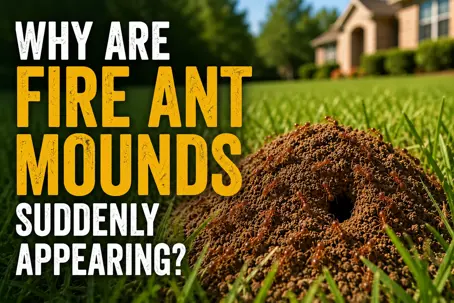
Why Are Fire Ant Mounds Suddenly Appearing in My Yard?
If fire ant mounds seem to be popping up in your yard overnight, the ants probably didn't just arrive.
In many cases, the colony was already established underground. Warm North Texas temperatures, rainfall, changing soil moisture, and colony growth can suddenly make fire ant activity much easier to see.
Rain is an especially common trigger. As soil conditions change, fire ants may build, repair, or relocate portions of their mound, creating fresh piles of soil that seem to appear almost overnight.
So if you're wondering, “Why do I suddenly have fire ants in my yard?” there's a good chance they've been nearby longer than you realized.
Fire ant mounds showing up where your family or pets spend time?
Myles Pest Services offers fire ant treatments for North Texas properties. We can inspect the activity around your yard and help determine the appropriate treatment.
Contact Us About Fire Ant Treatment
Why Do Fire Ant Mounds Seem to Suddenly Appear?
Fire ants spend most of their time underground.
The mound you see above the lawn is only the visible portion of a much larger colony and tunnel system beneath the soil. That means a yard can have fire ant activity before a large mound becomes obvious.
Fire ants continually build, repair, and adjust their mounds in response to environmental conditions. When North Texas receives rain followed by warm weather, changing soil conditions can make mound-building much more noticeable.
To a homeowner, it can look like several colonies moved into the yard overnight.
In reality, some of those colonies may have already been there.
Where Do Fire Ants Come From?
Fire ants live in colonies primarily below ground, so the mound isn't where the entire colony lives.
A colony can become established in a lawn or landscaped area and remain relatively inconspicuous until conditions make above-ground mound building more noticeable. New colonies can also become established as fire ants spread into suitable areas.
That's one reason simply knocking down a visible mound doesn't necessarily solve the problem.
In growing North Texas communities, changes to the landscape can also affect where fire ants establish colonies. Construction, grading, new sod, landscaping, and irrigation all change soil and moisture conditions.
If a mound suddenly appears, the better question isn't always “Where did these ants come from overnight?”
It may be “What changed that made this colony easier to see?”
What Attracts Fire Ants to Your Yard?
Having fire ants doesn't mean your yard is dirty or poorly maintained.
Fire ants are looking for conditions that allow a colony to survive, including suitable soil, moisture, food, and places to establish their underground tunnels.
Several conditions around North Texas properties can support fire ant activity.
Moisture
Irrigated lawns, areas around sprinkler systems, and soil that retains moisture can provide favorable conditions for fire ants.
Food
Fire ants are opportunistic feeders. They feed on insects and other available food sources around a property.
Suitable Soil
Lawns, landscaped areas, and other open ground can provide places for colonies to establish underground.
Disturbed Ground and New Landscaping
Construction and landscaping can change soil and moisture conditions around a property.
In rapidly growing North Texas communities such as Northlake, Argyle, Justin, Haslet, and Roanoke, homeowners may notice fire ant activity around newly landscaped or disturbed areas.
Having fire ants doesn't necessarily mean you've done something to attract them. Your yard may simply provide conditions where a colony can survive.

Why Do I Have Fire Ants in My Yard?
North Texas provides many of the conditions fire ants need.
Warm temperatures allow colonies to remain active for long periods, while rainfall, irrigation, landscaping, suitable soil, and available food sources can create favorable conditions around residential properties.
That's also why one home may have several visible mounds while the yard next door appears to have none.
Conditions can change throughout the season. A part of the lawn that didn't show obvious activity earlier in the summer may suddenly develop visible mounds after rain or changes in irrigation.
And because much of the colony remains underground, no visible mound doesn't necessarily mean no fire ants are present.
Why Do Fire Ant Mounds Appear After Rain?
Rain doesn't create fire ants, but it can make their activity much easier to notice.
After rainfall, changes in soil moisture can cause fire ants to repair, rebuild, or relocate portions of their mound. Freshly moved soil can produce the large, obvious mounds homeowners notice after a storm.
That's why you may walk outside after a rainy stretch and suddenly find several mounds that weren't obvious before.
The colonies may have already been established beneath the lawn.
Rain can affect other types of ants, too. If you've noticed a broader increase in ant activity following wet weather, read Are Summer Rains Making Ant Problems Worse in North Texas?
Why Are Fire Ants More Noticeable During Summer?
Summer is one of the times North Texas homeowners are most likely to notice fire ant activity.
Warm conditions allow colonies to remain active, and summer weather can bring alternating periods of dry soil, irrigation, and heavy rainfall.
It's also when we're spending more time outside.
Children are playing in the yard. Homeowners are mowing and gardening. Pets are spending more time outdoors. Families are using patios, pools, sidewalks, and other outdoor spaces.
That makes it much more likely that someone will encounter a mound that may have gone unnoticed before.
Fire ants are also only one of several ant species that become more noticeable during our North Texas summers. For a broader look at seasonal ant activity, read Why Are Ants Suddenly Everywhere in North Texas This Summer?
Where Do Fire Ants Build Their Mounds?
Fire ant mounds can appear throughout lawns and landscaped areas.
Homeowners may find them:
- Throughout front and back lawns
- Along sidewalks and driveways
- Around mailboxes
- Near landscaping beds
- Beside fences
- Around air-conditioning units
- Near irrigation systems
- Around playground equipment and other outdoor living areas
The visible mound is only part of the colony.
Most activity occurs beneath the surface, which is one reason knocking over a mound isn't the same thing as eliminating the colony.
Are the Red Ants in My Yard Fire Ants?
Not necessarily.
Color alone isn't enough to determine whether an ant is a fire ant. North Texas is home to several ant species, and identifying ants based only on whether they look red, brown, or black can be misleading.
Fire ants are often reddish-brown, but size, behavior, mound characteristics, and other identification features also matter.
If you're seeing ants around your property and aren't sure what you're dealing with, read Common Ant Species in North Texas.
When identification affects how the problem should be treated, having the ants professionally identified can help avoid treating the wrong pest.
Are Fire Ants Dangerous?
Fire ants are more than just a nuisance because they aggressively defend their colony when it's disturbed.
Someone who accidentally steps on or disturbs an active mound can be stung multiple times as worker ants respond.
That makes the location of the mound particularly important.
A colony next to a children's play area, patio, sidewalk, dog run, or other frequently used part of the yard creates a different concern than one located in a rarely used portion of a large property.
If someone experiences a serious reaction after being stung, seek appropriate medical care.
Should You Knock Down a Fire Ant Mound?
Knocking down the visible mound doesn't eliminate the colony living beneath the soil.
The ants may simply rebuild it.
That's also one reason homeowners can become frustrated when they treat what they can see and another mound appears later.
The same basic problem occurs with many types of ants: killing the visible ants isn't necessarily the same thing as addressing the colony.
If you've repeatedly treated ants only to see them return, read Why Do Ants Keep Coming Back After I Spray Them?
Tired of Treating One Mound Only to Find Another?
Fire ants aren't included in our recurring General Pest Control service, but Myles Pest Services does offer separate fire ant treatments. If you're seeing multiple mounds or recurring activity, contact us to discuss treatment options for your property.
Can You Prevent Fire Ant Mounds?
It's difficult to guarantee that a North Texas yard will never have fire ants.
They're outdoor insects capable of establishing colonies wherever conditions are suitable.
What homeowners can do is pay attention to the property and address activity when it appears.
Helpful steps include:
- Check your yard regularly for new mounds
- Pay extra attention following periods of rain
- Watch areas around irrigation systems
- Be cautious around newly disturbed soil
- Keep children and pets away from active mounds
- Avoid disturbing a mound if you're unsure how to treat it
If you're seeing ants inside your home or dealing with species other than fire ants, our Ant Control page explains how Myles approaches other ant problems around North Texas homes.
Fire ants are handled separately from our recurring General Pest Control service.
When Should You Consider a Fire Ant Treatment?
Finding one mound doesn't necessarily mean you have a major problem. But there are situations where professional treatment becomes more useful.
You may want to consider a fire ant treatment when:
- Multiple mounds are appearing across the property
- Mounds repeatedly return
- Fire ants are active near patios, play areas, sidewalks, or other frequently used spaces
- Children or pets regularly use the affected area
- DIY treatments haven't provided the results you expected
- You're unsure how widespread the activity is
Myles Pest Services offers standalone fire ant treatments for North Texas properties. These treatments are separate from our recurring General Pest Control service.
The goal is to address the fire ant activity on the property rather than simply knocking over the mounds you can see.
What If Fire Ants Aren't Your Only Outdoor Pest Problem?
Sometimes fire ants are only part of what's making a North Texas yard uncomfortable.
You may also be dealing with mosquitoes around the patio, fleas or ticks where pets spend time, chiggers, visible wasp nests, or lawn pests.
For homeowners looking for broader outdoor pest protection, Myles Pest Services also offers an Outdoor Living Program.
The program covers:
- Mosquitoes
- Fire ants
- Fleas and ticks
- Chiggers
- Visible wasp nests
- Armyworms
- Webworms
If fire ants are your primary concern, you can ask us about a standalone fire ant treatment.
If you're dealing with several outdoor pests, ask us whether the Outdoor Living Program makes more sense for your property.
Because these services don't currently have dedicated pages on our website, contact Myles Pest Services and we'll help you determine which option fits what you're experiencing.
Related Articles
- Why Are Ants Suddenly Everywhere in North Texas This Summer?
- Are Summer Rains Making Ant Problems Worse in North Texas?
- Why Do Ants Keep Coming Back After I Spray Them?
- Common Ant Species in North Texas
- Ant Control in North Texas
Frequently Asked Questions About Fire Ants
Where do fire ants come from?
Fire ants live in underground colonies, so they can be present in a yard before a large mound becomes visible. Colonies establish in suitable soil and can become more noticeable as weather, moisture, and colony activity change. A mound that suddenly appears doesn't necessarily mean the fire ants arrived overnight.
What attracts fire ants?
Fire ants look for suitable soil, moisture, food, and conditions where a colony can survive. Irrigated lawns, landscaping, available food sources, and disturbed soil can all support fire ant activity. Having fire ants doesn't necessarily mean there's anything wrong with how you're maintaining your yard.
Why do I have fire ants in my yard?
North Texas provides favorable conditions for fire ants, including warm temperatures and a long active season. Rainfall, irrigation, landscaping, suitable soil, and available food can support colonies. Because most of the colony is underground, you may not realize fire ants are present until a mound becomes visible.
Why did fire ant mounds suddenly appear after it rained?
Rain changes soil moisture and can make fire ant mound-building more noticeable. Fire ants may repair or rebuild portions of a mound following changes in soil conditions, leaving behind fresh piles of soil. The colony may have already been present before the mound became obvious.
Are red ants fire ants?
Not all red or reddish ants are fire ants. Color alone isn't enough for reliable identification. Size, behavior, mound structure, and other physical characteristics can help distinguish fire ants from other ant species found in North Texas.
Can I just knock down a fire ant mound?
Knocking down the mound doesn't eliminate the colony living beneath the soil. Fire ants can rebuild the mound or create visible activity elsewhere. If mounds repeatedly return, it may be worth considering treatment that addresses more than what you can see above ground.
Are fire ants included in regular pest control?
At Myles Pest Services, fire ants are not included in our recurring General Pest Control service. We offer standalone fire ant treatments, and fire ants are also covered under our Outdoor Living Program. Contact us if you're unsure which option makes the most sense for your property.
Ready to Do Something About the Fire Ants in Your Yard?
If fire ant mounds keep appearing around the places where your family spends time, treating only what you can see may not address the larger problem beneath the lawn.
Myles Pest Services offers standalone fire ant treatments for North Texas homeowners.
If fire ants are only one of several pests making your yard harder to enjoy, you can also ask about our Outdoor Living Program, which covers mosquitoes, fire ants, fleas and ticks, chiggers, visible wasp nests, armyworms, and webworms.
We'll help you determine which option makes sense based on what's actually happening around your property.